top of page

Once upon a time, I had the opportunity to work with some pretty wicked smart advertising professionals, the founders of the agency formerly known as Zippatoni, a 350-person St. Louis-based advertising agency with firms in five major cities, and clients like Motorolla, Dewers Scotch, Ralston Purina, Anheuser-Busch, Chicken of the Sea, Miller Brewing Company, Verizon, Sony, and more.


They told me that in order to get on their level and think like they do, I needed to read two books, well, for starters, at least.


🌟📚 The Tipping Point, by Malcolm Gladwell

🌟📚 Contagious, by Jonah Berger


I now recommend both of these to every marketing student I come across (and about 97 other books, but I digress).


The Tipping Point will give you the mental model needed to understand the psychology behind the types of actors responsible for spreading your ideas and creating truly contagious and viral events. Gladwell basically takes the Theory of Diffusion of Innovation Curve and points to a segment of those responsible for creating the momentum needed to get to the top of the curve, where what follows is explosive growth and full adoption of a new idea, product, or service.


Contagious will allow you to see all future innovations in media platforms through the lens that matters, i.e., the human behavior triggers that make people want to engage and share content, no matter how much noise is out there. The book ties straight into Maslow's Hierarchy of Needs, pointing to the intrinsic need to want to belong and feel valued. The reason we share content is that it gives us a way to create value by sharing something of value for the circles we walk in, a social currency that we trade back and forth.


Platforms and outlets are ever-changing, but human connection will always be relevant. If you're interested, I suggest reading The Tipping Point first and then Contagious to turn your ideas into the kind of stories that don't just stick but spread like wildfire.
Self-awareness is one of the most sought-after skills in hiring executives.


A recent Harvard Business Review study found that most leaders think they are self-aware, but not surprisingly, less than 15% have the skills to make that claim.


Instead of asking how to become more self-aware, start by asking how you can serve. What can you do better to show up and be there for your customers, colleagues, vendors, and even the barista you get your coffee from every morning?


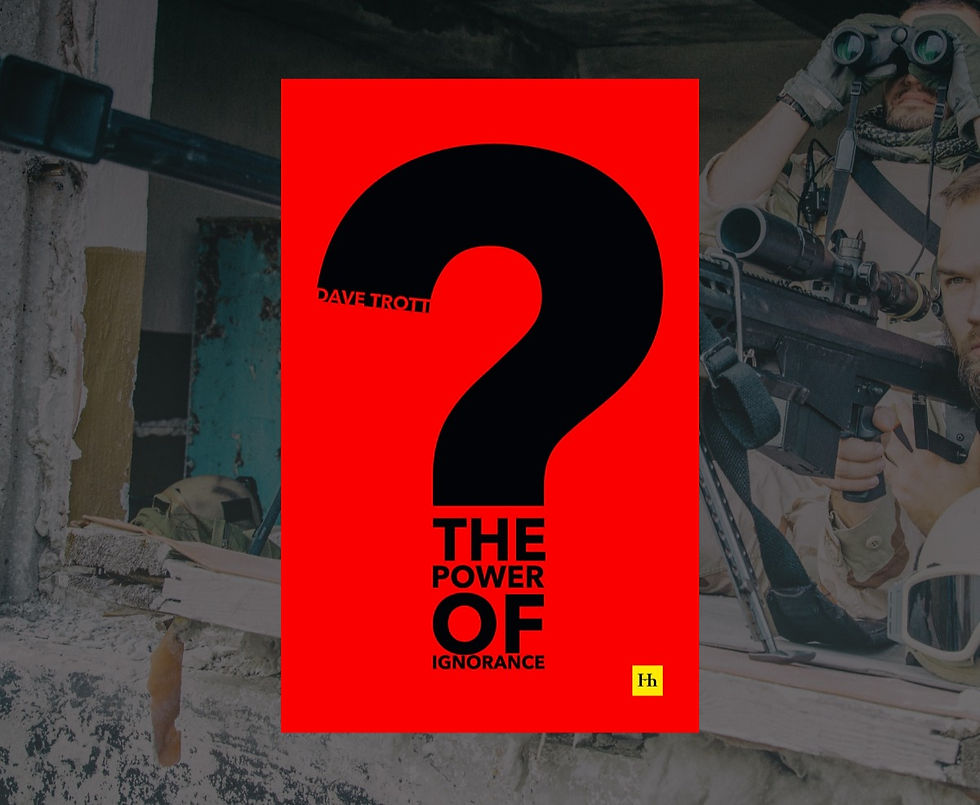
The story below is a favorite of mine from one of Dave Trott's classics, The Power of Ignorance, showcasing the incredible impact of quality service, a reminder of just how impactful true servant leadership can be.


"The best sniper rifle in the world is the Barrett M107. It’s a 50-caliber semiautomatic rifle and fires a bullet twice the size and power of a normal brand. It's accurate to well over a mile.
So the world's elite forces use the Barrett M107.
In Afghanistan, a unit of US Marines got into a firefight. Normally this wouldn't be a problem, they were equipped with a Barrett rifle.
But the Barrett kept jamming, the one thing you don't want a gun to do in a firefight. This was now a life-or-death situation.
So a young marine did the one thing only an American would think to do. Something that wouldn't even occur to a soldier of any other nationality in combat.
As the marine was in a firefight, he was too far from base to call for the armorer, and he didn't have any tools with him. So he called Barrett Firearms Manufacturing in Tennessee, USA.
When the receptionist answered, he asked to be put through to customer service.
Don Cook was the person who took the call. He asked what the problem was, he could hear the sound of a firefight in the background.
The young marine explained that his gun was jamming. He wondered if customer service could help.
Don Cook identified the problem, the lower receiver was bent. He was able to suggest what we would call a hack. He told the young marine to remove the bolt carrier and use the bottom part of it to bend the lower receiver back into position.
The young marine reassembled the Barrett and fired a few rounds. When they were both satisfied it was working properly, the marine thanked him and hung up to continue the firefight.
The whole process had taken less than a minute. Now THAT is what you call customer service. In combat where it literally means the difference between life and death."

Service is never the shiny object; it's the foundation waiting to be unearthed. Seeking opportunities to serve reveals the true value of skills like active listening, empathy, and emotional intelligence. As you embrace these, you'll find yourself eager to learn and grow—not for personal gain, but to offer the best version of yourself to others.


Reflection Questions:
  • How responsive is your organization when prospects and customers reach out? Can a customer count on you during an emergency? Can they expect a timely response, or do you make them wait on hold? Are there opportunities where customers will rave about just how personable and timely you are and how amazing it is to work with you?


  • Are you fully present with colleagues and casual acquaintances? Something as simple as keeping your phone in your pocket, or moving your chair away from being able to reach your keyboard or look at a screen so that your full attention is one the individual that just walked into your office can make the world of difference.


  • What are you doing to create more opportunities to listen to more than the usual contributors? Do you create the space for introverts and extroverts alike to speak up? Do your colleagues feel like they can share and collaborate on an equal playing field towards a positive outcome, or does pride and envy get in the way of progress?

Smart businesses know that success isn't about reaching everyone; it's about reaching the right people at the right time with the right message. 


The Right People

Good-to-great customers are the type of customers who have a pressing need for what you do, can easily afford you, and are happy to pay for results. Where good customers become great is subjective, but often, it comes down to their potential for organic growth. A good customer might love what you do but only buy from you once. A great customer might be someone with an ongoing need, with a high potential for repeat business and a potential to purchase additional products or services as time passes. 


Pays-the-bills customers check the boxes, but their unique situation creates less demand than good-to-great customers. These might be customers who can afford some of your products and services but are not large enough to meet your ideal account goals. They can buy new tires at the service center, but they can't afford a new car off the lot. These customers still hold value because they help keep the lights on, can serve as phenomenal ambassadors for your reputation, and even generate referrals to bigger fish. Still, when it comes to where you place your marketing dollars, it's good to understand some of their characteristics to invest appropriately. 


Unqualified leads are those who need what you do but can't afford your products or services. You don't have to talk exact numbers, but you owe it to your team's time to qualify or disqualify a lead based on their financial position as early as you can. If you don't, you'll run the risk of being strung along till you reach the one-yard line, only to find out they never had the budget to afford what you have to offer.


Toxic customers are those you should actively protect your business from. From rude clients who don't respect your team members and actively fuel burnout to those who never seem to pay on time, understand what toxic characteristics are the most disruptive to your business so you can steer clear. You might not find out till after you sign them as a new client, or they may be big fish accounts that are tempting to work with to cash in on their business, but customers who treat your people like trash will threaten the very thing that makes your business great. Invest in your people; the rest will follow.


Segmenting your audience like this is how you scale marketing teams of one and beyond.

As Todd Henry discusses in his book Herding Tigers, your people need two things from you more than anything: stability and challenge. A wide-open playing field is not helpful to the creative process. When you position your marketing strategy based on the customers who will grow your business while actively protecting it from the leads who threaten it, you will have the freedom of operating in a more predictable environment, allowing you to focus your time and energy on the activities that produce results, while protecting that same time and energy from real threats to your business.

bottom of page